With just days to go before the kickoff of the 2026 FIFA World Cup co-hosted by the US, Canada and Mexico, a referee poised to make history has been barred from entering the US by customs officials, dashing his World Cup dream.According to Reuters, FIFA confirmed on June 8 local time that renowned Somali referee Omar Artan was denied entry upon arriving at Miami International Airport last weekend. He will be excluded from all pre-tournament referee training and officiating assignments for this World Cup.
Speaking on June 9, Artan struck an upbeat tone: “Despite everything that has happened, I remain positive and will focus on the next challenge in my refereeing career. I am grateful for all the support from FIFA and the Confederation of African Football (CAF). I pledge to uphold my professional standards and look ahead to future opportunities.”
The 34-year-old official is widely regarded as one of Africa’s finest referees of recent years. His entry rejection marks a devastating setback for his career, while casting fresh scrutiny on America’s increasingly restrictive immigration policies and the host nation’s dilemma between event openness and national security.
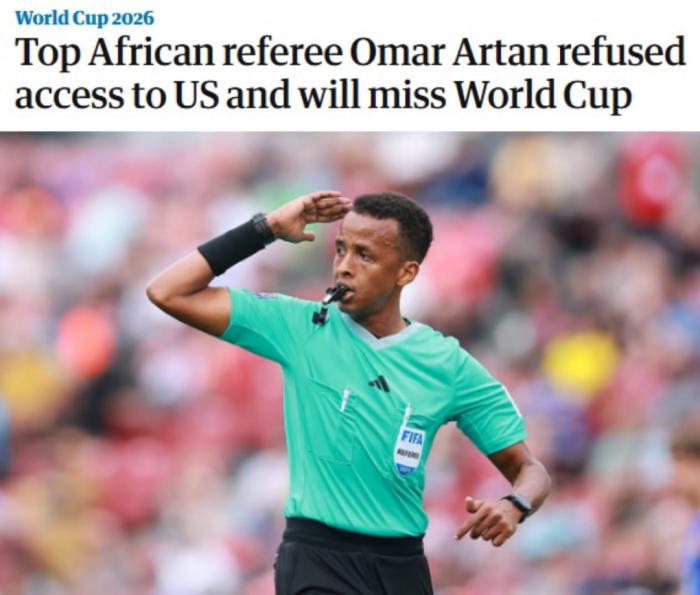
From Somali Streets to World Cup Aspirations: Africa’s Top Ref’s Dream Shattered in Miami
The World Cup stands as the ultimate career milestone for footballers, and the same holds true for match officials.
Artan earned his FIFA international referee badge in 2018. He has since officiated top-flight fixtures including Somalia’s domestic top division, the CAF Champions League and Africa Cup of Nations. In 2025, he was crowned CAF Men’s Referee of the Year, cementing his standing as one of the most prominent figures in African refereeing.
Earlier in 2026, FIFA unveiled its referee roster for the World Cup, naming Artan among 52 head referees. Had he taken charge of matches as planned, he would have become the first Somali referee ever to officiate at a FIFA World Cup — a landmark achievement of profound symbolic weight for Somalia, a nation long ravaged by war and poverty.
Yet his historic journey came to an abrupt halt at Miami Airport.
Citing the Associated Press, U.S. Customs and Border Protection (CBP) stated that a Somali national flying into Miami from Istanbul, Turkey, underwent secondary inspection and was ruled “inadmissible due to unresolved vetting concerns.” Though the statement did not name Artan directly, FIFA later verified the individual in question was the Somali top referee.
Notably, Artan travelled with a valid U.S. visa and had completed all mandatory pre-tournament paperwork required by FIFA, multiple foreign media outlets confirmed.
U.S. authorities nonetheless emphasise that possession of a visa does not guarantee entry, with final admission authority resting entirely with border enforcement agencies. CBP clarified that all travellers — athletes, coaches and tournament staff included — are subject to border screenings, and entry eligibility is assessed based on law enforcement records, national security data and immigration profiles.
Reuters further reported FIFA has distanced itself from the decision, stating it holds no sway over visa and entry rulings made by host countries. U.S. officials have informed FIFA that Artan’s entry ban will remain unchanged, permanently ruling him out of World Cup officiating duties.
The news sparked fierce backlash within Somalia’s sporting community.
Siis Aden Abshir, senior advisor to Somalia’s Ministry of Youth and Sports and former captain of the national football team, condemned the move. He described Artan as “one of Africa’s most respected referees,” arguing the U.S. decision violates the core sporting values of fair play upheld globally by football.
The Guardian and other international outlets quoted public opinion in Somalia, framing the incident as not merely a personal loss for Artan, but “a major setback for Somali football.”
Photo caption: June 2 local time. Ahead of the 2026 World Cup, New York retailers decorate venues with football-themed displays to draw customers. Pictured is a giant football installation inside a shopping mall.
World Cup Clashes with U.S. Travel Bans: Fresh Controversy Over Host Entry Rules
Analysts say the incident has garnered widespread global attention largely because it lays bare a highly sensitive conflict: the tension between the World Cup and U.S. immigration policy.
The 2026 World Cup is the largest iteration in FIFA’s history, featuring 48 teams competing across matches hosted jointly by the United States, Canada and Mexico. FIFA estimates millions of fans, journalists, players and tournament personnel will cross international borders over the competition, making the entry rules of host nations a focal point of global attention.
Reports from Reuters and Canadian Press note the U.S. government has steadily tightened visa and immigration regulations over the past 12 months. Washington has imposed new travel restrictions covering 12 countries including Somalia, citing national security risks and identity vetting issues. While exemptions exist for athletes and select tournament participants, Artan’s case proves valid visa holders can still face rejection at border screenings.
Such risks had already raised widespread concerns throughout World Cup preparations.
Multiple international sports governing bodies lobbied the U.S. government to guarantee seamless entry for competing athletes, officials, media and supporters. FIFA President previously pledged a welcoming environment for all World Cup participants — a promise now cast in shadow by Artan’s ordeal.
A further complicating factor is the highly integrated tournament organisation across the three co-hosts. Mandatory pre-competition arrangements including unified referee training, fitness assessments and technical briefings are predominantly held on U.S. soil. Even though some matches will take place in Canada and Mexico, any referee barred from entering the United States cannot join the unified World Cup officiating team at all.
Observers argue the case exposes a long-standing friction between major global sporting events and national sovereignty. FIFA holds authority to select World Cup referees, yet cannot override a sovereign nation’s border entry jurisdiction; meanwhile, unilateral border restrictions imposed by the host risk undermining the tournament’s fairness and global inclusive image.
For Omar Artan, the controversy has cost him the biggest stage of his professional career. For the 2026 World Cup, soon to command global spotlight, this dispute may only mark the start of broader friction.
As players, referees, staff and fans from every corner of the globe continue arriving in North America, how the United States strikes a balance between national security imperatives, strict immigration policy and the openness demanded by a landmark global sporting event will remain an unavoidable talking point throughout the World Cup.